Question 1
Why are helicopters used?
- Delivering food offshore.
- MEDIVAC.
- Crew transfer.
- Pilot transfer.
- Winching renewable equipment sites.
- To transport drilling equipment to rigs.
Study guide
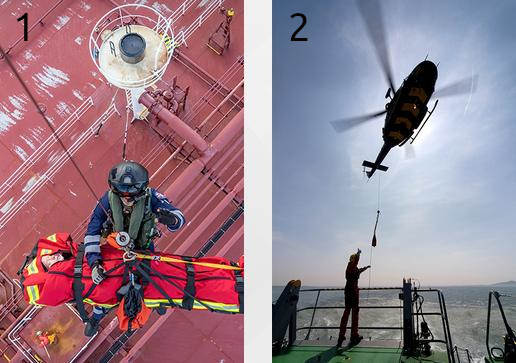
Download PDFHelicopters reach ships that no boat can, whether to lift a casualty off in a medical emergency or to move personnel. This guide covers the helideck, the equipment, the crew's PPE and the training.[1][2]
Helicopters are used for MEDIVAC, crew transfer, pilot transfer, and winching personnel and equipment to renewable-energy sites.
The physical characteristics of helidecks are outlined by CAP 437. These include markings and colours that fit the colour code — the deck is always green and the lettering is white; the helideck area, or "D Value", which is the largest overall dimension of the helicopter with rotors turning; and windsocks that show which way the wind is blowing.
To land a helicopter on a ship without a designated area, ensure that flags and pennants are flown to indicate wind direction; that at night the area is well lit with no glare; that no loose equipment or debris is in the vicinity to avoid accidents from downdraft; and that deck personnel are wearing the correct PPE.
The helideck crew require safety boots or shoes, eye protection, and ear protection.
As per SOLAS and GMDSS procedures, all ships should be fitted with communication equipment and have clear communication protocols to follow. Drills prepare the crew for emergencies such as fire, abandon ship and collision. Note that it is possible to carry dangerous goods by air (with the applicable rules). Familiar items of helideck equipment include the wheel chock; operations include the Hi-Line and winching.
Helicopter training covers escaping from an overturned helicopter to a life raft or into the water, together with the necessary sea survival, including rescue and recovery (the Helicopter Underwater Escape Training).
Compiled from the sources above and cross-checked against the official documents. Published by the MaritimeTest editorial team.
The correct answer is marked. Unlock the rest to study the whole test, online or offline.
Find the exact question in Helicopter Operations at Sea and see the correct answer.
Paste a phrase from a question — word for word works best. The correct answer is marked in green.
Question 1
Question 2
Question 3
Question 4
Question 5
Preview — 5 of 10 questions
You are seeing the first 5 questions with answers. Unlock the remaining 5 to study the whole test — online or offline.