Skip to content
MaritimeTest

COLREGS General

Mintra 24 questions

Study guide

Download PDF

The COLREGs are the international rules that keep ships apart at sea. This guide covers where they apply, the key manoeuvring rules, sound signals, lights and shapes, and the special rules for narrow channels and traffic separation schemes.[1]

Application

The COLREGs apply to all vessels upon the high seas and in all connected waters. In territorial waters, additional national regulations may apply. Beyond the required visible actions, the rules also demand good seamanship.

Avoiding collision

Actions taken to avoid collision must be clearly visible to other vessels, which in practice means one large manoeuvre rather than a series of small ones. When taking collision-avoidance action, consider the available safe water.

The stand-on vessel may need to act: if early actions have failed and the vessels are close, it must do whatever manoeuvre is necessary to avoid a collision, and it may alter course or speed if it becomes clear that the give-way vessel is not taking appropriate action. In a crossing situation, a stand-on vessel taking action should avoid altering to port, so as not to counter any action the give-way vessel might still take. Some vessels must be given room: the rules may require a vessel not to impede the safe passage of another (for example one restricted by its draught), and such action should be taken early to leave sufficient sea-room; it does not relieve the other vessel of its own obligation to avoid collision.

Restricted visibility and sound signals

In reduced visibility, if you hear a fog signal that appears to come from forward of your beam and you cannot locate the other vessel visually or by radar, reduce speed to the minimum and navigate with extreme caution.

One prolonged blast means different things depending on conditions: in restricted visibility it indicates a power-driven vessel making way through the water; in good visibility it signals that a vessel is approaching a bend or an obscured area.

Lights and shapes

Recognising lights and shapes identifies a vessel's type and status:

  • a white stern light means the vessel is moving away from you;
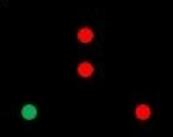
  • a vessel showing the not-under-command lights may still be making way through the water;
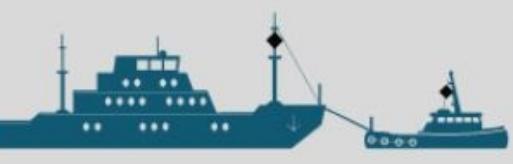
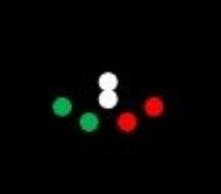
  • a tow over 200 m, or a vessel under 50 m towing a tow under 200 m, is identified by its day shapes; a vessel constrained by its draught shows the relevant day shape;
  • lights and shapes also identify fishing vessels (non-trawling), sailing vessels, mine-clearance vessels, and vessels engaged in underwater operations with an obstruction on one side.

On the visibility of lights: masthead lights are visible over a greater range than other lights, and longer vessels are generally required to have a higher range of visibility.

Traffic separation schemes

In a traffic separation scheme (TSS), vessels entering or leaving a lane should keep a small angle to the direction of traffic. Where possible, ships should join or leave the TSS at the beginning or end of the lane with particular caution, and any vessel not using or crossing the scheme should keep a wide distance from it.

Narrow channels

All vessels travelling along a narrow channel should stay as much to their starboard side as is safely possible, and avoid anchoring. Ships approaching a bend or a visually obstructed area should sound one prolonged blast to warn others; any approaching vessel that hears this signal should also sound one prolonged blast in answer.

Key facts to remember

  • COLREGs apply to all vessels on the high seas and all connected waters; territorial waters may add national rules.
  • Avoid collision with one large, clearly visible manoeuvre; mind the available safe water.
  • Stand-on vessel must act when the give-way vessel fails; avoid a port alteration in a crossing.
  • One prolonged blast: restricted visibility = power-driven under way; good visibility = approaching a bend.
  • Fog signal forward of the beam, vessel not located → minimum speed, extreme caution.
  • TSS: small angle in/out, join/leave at the lane ends, stay well clear if not using it.
  • Narrow channel: keep to starboard, no anchoring; bend signal → one prolonged blast, answered likewise.

Sources

  1. Convention on the International Regulations for Preventing Collisions at Sea, 1972 (COLREGs), as amended — IMO (Parts A–D, Rules 1–19 and Annexes).

Compiled from the sources above and cross-checked against the official documents. Published by the MaritimeTest editorial team.

First 5 of 24 questions — with answers

The correct answer is marked. Unlock the rest to study the whole test, online or offline.

  1. Question 1

    You are underway in an area of reduced visibility and hear a sound signal. It is likely coming from the starboard bow; however you cannot locate the other vessel either visually or with the radar. Which of the following actions should you take?
    • As the sound signal appeared to come from forward of your vessel's beam, you should reduce speed to the minimum and navigate with extreme caution.
    • As the sound signal appeared to come from starboard side, you should alter your course to starboard and carefully pass astern of the other vessel.
    • As the sound signal appeared to come from forward of your vessel's beam, you should alter your course to port side and observe the situation.
    • You should immediately clarify the situation with a radio call, since you cannot detect the other vessel.
  2. Question 2

    You have visually detected a vessel displaying the lights below. What is the status of this vessel?
    You have visually detected a vessel displaying the lights below. What is the status of this vessel?
    • Not under command.
    • Not making way through the water.
    • Making way through the water.
    • Constrained by their draught.
    • Restricted in their ability to manoeuvre.
  3. Question 3

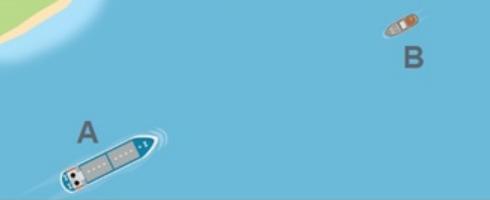
    Take a look at the scenario being shown on screen now. Which of the vessels should take action to avoid a collision and what should that action be?
    Take a look at the scenario being shown on screen now. Which of the vessels should take action to avoid a collision and
    • The vessel(s) should alter their course to starboard side until a safe passing distance is predicted.
    • Both vessels should take action.
    • The vessel(s) should alter their course to port side until a safe passing distance is predicted.
    • The vessel(s) should reduce their speed until a safe passing distance is predicted.
    • Only vessel A should take action.
    • Only vessel B should take action.
  4. Question 4

    You have visually detected a vessel displaying the day shapes below. What is this status of this vessel?
    You have visually detected a vessel displaying the day shapes below. What is this status of this vessel?
    • Vessel towing another vessel, length of the tow is over 200 m.
    • Vessel towing another vessel, length of the tow is less than 200 m.
  5. Question 5

    You have visually detected a vessel displaying the lights below. What is the size and status of this vessel?
    You have visually detected a vessel displaying the lights below. What is the size and status of this vessel?
    • Vessel under 50 m in length towing, total length of the tow is under 200 m.
    • Vessel over 50 m in length towing, total length of the tow is under 200 m.
    • Vessel over 50 m in length towing, total length of the tow is over 200 m.
    • Vessel under 50 m in length towing, total length of the tow is over 200 m.

Preview — 5 of 24 questions

You are seeing the first 5 questions with answers. Unlock the remaining 19 to study the whole test — online or offline.

Related Mintra tests